Young Vic: Cast announced for The New Tomorrow

Young Vic

Kwame Kwei-Armah, Artistic Director of the Young Vic, today announced the cast of The New Tomorrow, a weekend of pop-up performances celebrating the Young Vic’s 50th birthday. The New Tomorrow– the first piece of live theatre at the Young Vic since the pandemic closed UK theatres in March – will interrogate
the change that has come and is coming, and what the next 50 years might hold.

Ronkẹ Adékọluẹ́jọ́, Adjoa Andoh, Matthew Dunster, Paapa Essiedu, Martina Laird, Anoushka Lucas and Sophie Stone will perform short works from writers and artists Jade Anouka, Marina Carr, Jasmine Lee-Jones, Ruth Madeley, Amy Ng, Stef Smith, Jack Thorne, Isobel Waller-Bridge and Steve Waters, directed by Young Vic Genesis Fellow and Associate Director Jennifer Tang. The performance will be hosted by Kwame Kwei-Armah, and also feature speeches from activists Shahidha Bari and Tom Gill, with Kwame Kwei-Armah Jr. as DJ.

Tickets for The New Tomorrow have been previously won via ticket lottery, however the performance will be live streamed for free from the Young Vic
via Facebook Live on Sunday 4 October at 4pm.

Together with the 50th Projection Project and The Unforgotten, The New Tomorrow marks the beginning of We are the New Tide, the Young Vic’s year-long 50th birthday programme which will run until September 2021.

The New Tomorrow is co-produced with Benjamin Lowy and Emily Vaughan-Barratt for Wessex Grove.


Birmingham Repertory Theatre announce the commissioning of 12 new plays

Today, Birmingham Repertory Theatre has announced 12 new commissions titled The Park Bench Plays– a series of micro-plays that illuminate, interrogate and even celebrate today’s socially distanced world.
Brainchild of The REP’s Artistic Director Sean Foley, this series of brand-new commissions will bring together the work of some of UK theatre’s biggest writing talents and comedians alongside emerging playwrights to create a suite of new plays.

Made possible thanks to the generous support of The Sir Barry Jackson Trust, these new plays by The REP feature some of the UK’s biggest writing talents amongst emerging playwrights including; Gurpreet Kaur Bhatti (A Kind of People/Khandan), Janice Connolly (Mrs Barbara Nice/Stuff), Rachel De-Lahay (The Westbridge/Circles), David Edgar (Nicholas Nickleby/Pentecost), Robin French (Cuckoo/RebelMusic),  Tanika Gupta (Lions and Tigers/The Empress), Bryony Lavery (Frozen/The Lovely Bones), Sabiha Mank (The REP Discovery Artist), Amerah Saleh (Author ‘I Am Not From Here’/Commonwealth Games Handover Poet), Frank Skinner (The Frank Skinner Radio Show/Frank Skinner’s Poetry Podcast), Liam Steel (Director/Adaptor– Peter Pan/The Wizard of Oz) and Jack Thorne (His Dark Materials/Harry Potter And The Cursed Child) & Lettie Precious (This Is Us/The Break – BBC 3). The ten-minute-long plays have been written to be performed in pop-up locations throughout Birmingham – at bus stations, community centers, parks, public squares,foyers and train stations – surprising and delighting commuters, shoppers, residents and others going about their daily business in the city and its environs. The series of plays will be directed by The REP’s Artistic Director, Sean Foley, Deputy Artistic Director, Amit Sharma and Associate Director, Madeleine Kludje.

The REP’s Artistic Director, double Olivier Award-winning Sean Foley said; “The Park Bench Plays will bring together the work of some of the UK’s biggest writing talents for an exciting and diverse collection of micro-plays. “Considering the ongoing effects of the COVID-19 pandemic on our industry, we at The REP feel it is important to continue to employ artists and create work for
audiences.“From comic to serious, tragic to hysterical, this collection of two-hander plays take ordinary and everyday conversations and make them extraordinary and
timeless – they all have a sense of fun and provide a living snapshot of our socially distanced, somewhat disturbed world.
“We look forward to sharing this extraordinary collection of works with audiences when the time is right to do so in the future and to continuing working with
this wonderfully eclectic set of writers.” 

Comedian Frank Skinner commented; “I’m really properly excited to be part of this project with The REP. I’ve had some life-changing experiences on park benches in the West Midlands but I’m hoping this one will be a bit easier on the elbows.”

Playwright Tanika Gupta added; “I am thrilled to have been asked by the The REP to write a piece for this collection of eclectic new plays. In this time of uncertainty, it is greatly welcome to see venues such as The REP actively engaging with artists to continue in efforts to make new work. I am excited to be writing for live theatre again, alongside my fellow eleven fantastic playwrights.”

The REP Discovery Artist, Sabiha Mank said; “As soon as I was approached about taking part in The Park Bench Plays, I couldn’t wait to get started. Coming out of lockdown, this project has been a dream to be a part of and a brilliant way of trying to make sense of the world.” The Park Bench Plays were to have had their first outing during October, but local restrictions coupled with the new national restrictions have made that impossible. As soon as it is safe to resume outdoor performances, The Park Bench Plays will be put into production to then begin their pop-up tour around the city.
To find out more about The REP and their work with creatives and emerging artists visit birmingham-rep.co.uk.


National Theatre releases new podcast series: That Black Theatre Podcast

National Theatre

The National Theatre is launching a new Podcast Series: That Black Theatre Podcast. Hosted by Arts and Humanities Research Council-funded PhD Student, Nadine Deller the podcast is a partnership between the National Theatre, The Royal Central School for Speech and Drama, University of London and the AHRC London Arts and Humanities Partnership.

Starting on the 28 September, over the course of 12 weekly episodes, Nadine will delve into the Black Plays Archive, discussing the leaders of Black British theatre and the political and social events of the 20th and 21st Century that influenced their work.

Beginning with the earliest black theatre practitioners Una Marson and Errol John, the podcast will discuss the works of these trailblazers and the writers who followed, Mustapha Matura and Alfred Fagon, who wrote against the backdrop of the Civil Rights and Black Power movements both in Britain and America.  The barriers faced by black women playwrights will be debated with the leading academic, Lynette Goddard. With the plays of Valerie Mason-John and Jackie Kay discussed in relation to the under representation of black queer and lesbian experiences on stage.

Nadine Deller will conclude the series with an episode dedicated to Winsome Pinnock, conversations about debbie tucker green and Roy Williams, as well as discussions with lead theatre makers both looking to the past of Black British theatre and to the future, including Mojisola Adebayo and Ola Ince.

Speaking about the podcast Nadine Deller said, “This podcast started as a way to share what I have learnt about black British theatre with as many people as I could. I never learnt about black theatre in school, so this podcast is a celebration of black British theatre and the stories I have found in the archive. Through a mix of history, interviews, and casual discussion, I hope to show that black theatre is for everyone.”

That Black Theatre Podcast will be available for free via Apple podcasts, Spotify, Google podcasts, and all major podcasts platforms.

Chichester Festival Theatre announces reopening Autumn plans

CHICHESTER FESTIVAL THEATRE ANNOUNCES NEW AUTUMN SEASON

Artistic Director Daniel Evans and Executive Director Kathy Bourne today announce a live, socially distanced season of drama, music, comedy and cabaret at Chichester Festival Theatre, running from late October to early January.

It includes:

* Sarah Kane’s CRAVE, directed by Tinuke Craig, staged in a socially distanced Festival Theatre for 10 performances and live streamed to digital audiences


* For Christmas, a series of festive concerts to launch the yuletide season, followed by Chichester Festival Youth Theatre in a new version of PINOCCHIO by Anna Ledwich, directed by Dale Rooks

* Michael Ball, Sheila Hancock and Patricia Routledge in conversation with Edward Seckerson

* Cabaret and comedy including Frisky and Mannish, The Black Cat Cabaret, Barely Methodical Troupe, Rich Hall, Suzi Ruffell, Russell Kane and Rosie Jones

* Music ranging from a celebration of Sondheim with West End stars, to a song recital by Kate Royal, a new concert from Joe Stilgoe and a portrait of Rachmaninoff with Henry Goodman and Lucy Parham

* Prologue ticket scheme upper age range extended: £5 tickets now available for 16 – 30s
Artistic Director Daniel Evans and Executive Director Kathy Bourne said:

‘It’s always a pleasure to welcome audiences to a new Chichester season, but it’s with particular joy that we welcome them to this very special Autumn season, after six long months of our Theatre being dark and empty.

‘In putting together this eclectic mix of drama, music, cabaret and comedy, we hope there is something to entice people of all ages to experience once more the uniquely uplifting exhilaration of live performance. The season includes some distinguished names in drama and music, alongside ground-breaking contemporary performers.

‘We’ve worked long and hard to put all the necessary measures in place for our audiences’ and artists’ health and comfort, and to make their visit Covid-safe. While social distancing is in place, we are having to explore other forms of live performance to ensure the Theatre’s future sustainability. For now, we are celebrating that Chichester Festival Theatre’s doors are opening

BOOKING INFORMATION

Priority online booking for Friends of Chichester Festival Theatre opens: Wednesday 30 September from 9am
General online booking opens: Friday 2 October from 9am
cft.org.uk 01243 781312
Tickets from £10

Social distancing necessitates the auditorium being reduced to less than 50% of its normal capacity. Audiences are invited to consider donating the cost of an ‘empty’ £10 seat to support the Theatre’s activities, as well as our employment of freelance artists during the pandemic.

Prologue: £5 tickets for 16 – 30s
£5 tickets are available for 16 to 30 year-olds for all shows throughout Autumn 2020; sign up for free at cft.org.uk/prologue


New name announced for Colston Hall in Bristol

Bristol Beacon

Bristol Music Trust has today, Wednesday 23rd September 2020, revealed the new name for Colston Hall in a live streamed event on their website.

The new name, which will be adopted immediately, is Bristol Beacon.
With the restrictions imposed as a result of COVID-19, the announcement was conducted in the venue’s iconic foyer without a live audience or guests in attendance. Short speeches before the name was announced were given by Louise Mitchell, chief executive of Bristol Music Trust, and Bristol Mayor Marvin Rees. They were followed by a poem, especially created for the occasion by Bristol’s City Poet, Vanessa Kisuule, and captured in a short film using a diverse range of voices of the people of Bristol at locations around the city. The name was revealed for the first time in the last line of the poem, before returning live to Louise on the stage to welcome the change.

Louise Mitchell, said in her live broadcast speech: “This morning I am warmly welcoming you to Bristol Beacon. A symbol of hope and community. A focal point for music in the city. A gathering space, illuminating the way ahead. A place of welcome, warmth and light. We’re giving an open invitation to the city for everyone to come and share in the joy of live music. I look forward to developing our future with you.”

The name of the venue, and its associations with the slave-trader Edward Colston, has long been the focus for debate in the city. Colston Hall was founded 150 years after Colston’s death, with no financial investment or direct link to the man or his wealth. The charitable Trust – which has been responsible for the management of the venue and the city’s music education hub since it was established in 2011 – publicly declared in April 2017 that the venue would be renamed as part of the multi-million pound transformation that is currently in progress and following a substantial consultation process.

The Trust hopes that this moment serves as a fresh start for the organisation and its place in the city, with a focus on music performance and education. Writing on their website, the Trust stated: “We believe in the power of music to break down barriers and cross boundaries. Bristol Beacon will celebrate this in everything we do.

“You’ve told us that you want us to inspire more people through music. With this change, and the coming transformation of our building, we can do that together. Today marks the start of a new chapter as Bristol Beacon.”

Councillor Craig Cheney Bristol City Council’s Deputy Mayor with responsibility for Finance, Governance and Performance said: “I’d like to thank Bristol Music Trust, and all our partners involved, for the work done over the past few years with a consultation that gave thousands of people across the city the opportunity to share their views and speak into this decision.

“I welcome the new name as something that will help the venue reach out and connect with the whole city.  The connection with community, contending with our history and looking ahead resonate with our ambitions for the venue’s inclusive future as a world class arts and cultural venue to represent Bristol. It also runs in a parallel with the city conversation reflecting on our history and how this understanding can be represented in our future.

“For now, we look ahead to how this can become a place fully connected to its city communities, where everyone feels welcome and can enjoy coming to experience what Bristol has to offer.”

The historic occasion is also being marked in a way that Bristol does so well – with a beautiful visual light experience projected onto the building. Created by award-winning Bristol design studio Limbic Cinema, a shortened version of the projection appeared between sunset and midnight on Tuesday 22nd September in anticipation of the announcement, with the full version including the new name due to be projected on the evening of Wednesday 23rd September.

The name has been announced without a new logo. The Trust has stated the future identity for Bristol Beacon will be created in partnership with local young emerging creatives from Rising Arts Agency over the next few months, to help design something that is right for the new name and for the city.
As part of the announcement, Bristol Music Trust has  released the Bristol Beacon ‘Transformation Promise’ – a newly developed manifesto for change which includes a series of actions the organisation is committing to in order to improve the diversity of their audiences, programme and workforce – ensuring the name change is more than a symbolic move.. Part of this work will be enabled by a ground-breaking project in partnership with Paul Hamlyn Foundation, who are investing £400,000 into a major programme of community-led activity centred around the reopening of the venue.A leading artistic project has also been announced as the first piece of artistic work to take place under the banner of Bristol Beacon. The coming weeks will see a major new city-wide music project called
‘A New Song for Bristol’ launched, as part of their programme of work with National Lottery Heritage Fund. This will invite the people of the city to contribute to a musical archive of Bristol’s experiences of this historic year and their hopes for the future.
Additional videos, interviews and information about the renaming will be shared on the website throughout the announcement day. The full website will be back online on Thursday 24th September at

www.bristolbeacon.org. The venue’s social media accounts will change over to the new name straight after the announcement.

Bold new musical ‘P.S. I’m A Terrible Person’ to get a three-week fully-staged development workshop

P.S. I’m A Terrible Person

Pint of Wine Theatre Company announced a three-week development workshop of Francesca Forristal and Jordan Paul Clarke’s ‘P.S. I’m A Terrible Person’, a new dark comedy musical about addiction through the eyes of 16-year-old, Martha Weiss. 

The workshop will feature full staging with an innovative projected set design by acclaimed illustrator Larisa Bulb (larapickleart.com).

This show is the high before a caffeine-crash. It’s twisted, and funny, and addictive. Provoking frank, much-needed conversations about disordered eating with all the high-octane headiness of a modern musical.

Martha’s always in control: smashing school; managing her eccentric Mum; convincing hot, (straight) Alison to go on a date. So what, she has a bit of an obsessive personality? She’ll sort her eating disorder out, just like she sorts everything else. Piece of cake…

Based on real life events, we dive headfirst into Martha’s world, experiencing addictive rituals and NHS wards through her musical theatre-tinted spectacles. How can she explain compulsions that simply don’t make sense to “normal people”…? With a tap number, of course. It’s a big, energetic production musical which forces us to confront our own relationships with the best/worst parts of ourselves (often, one and the same). 

Two invitation-only performances will be held 22 and 23 October at 7:30pm at the Cockpit Theatre, Marylebone.

Principal casting includes: Nicole Raquel Dennis (Alana Beck in ‘Dear Even Hansen’, Noel Coward theatre;  Effie White, ‘Dreamgirls’, Savoy; ‘The Voice’, ITV), Piers Bate (understudy Dr. Jim Pomatter  in ‘Waitress’, Adelphi), Charlotte Vaughan (1st Understudy Carlotta in ‘The Phantom of the Opera’, Her Majesty’s), Lewis Cornay (Elder Cross, ‘The Book of Mormon’, Prince of Wales), Lottie Johnson (Logainne Schwartzandgrubenierre, ‘The 25th Annual Putnam County Spelling Bee’, Drayton Arms) and the show’s book writer Francesca Forristal as Martha Weiss. 

The rest of the cast features David Birch (‘Half A Sixpence’, Noel Coward Theatre; ‘Groundhog Day’, Old Vic), Ricardo Castro (‘Come From Away’, Phoenix Theatre; ‘Motown: The Musical’, Shaftsbury Theatre); Matthew Cavendish (‘The Play Goes Wrong’, Broadway; ‘Peter Pan Goes Wrong’, Apollo Theatre and UK Tour), India Chadwick, Phoebe Ellabani (‘Peter Pan Goes Wrong’, UK Tour), Kerri Norville (‘& Juliet’, Shaftsbury Theatre), Bethany Weaver (‘Broken Wings’, International Tour) and Natalie Moore Williams (‘Charlie and the Chocolate Factory’, Theatre Royal, Drury Lane). 

Creative team: 

Director: Ali James (Assistant Artistic Director, ‘Showstopper: The Improvised Musical’, Movement Director Mischief Theatre’s ‘Peter Pan Goes Wrong’ and ‘Magic Goes Wrong’) Choreographer: Lucie Pankhurst (‘Troilus and Cressida’, National Theatre and ‘Toxic Avenger’, Arts Theatre)

 Musical Director: Joe Bunker (‘The Rink’ and ‘Wasted’, Southwark Playhouse) 

Costume Designer: Zahra Mansouri 

Sound and Video Designer: Adrian Jeakins

 Sound Designer: Max Hunter

 Lighting Designer: Francis Clegg

Producer of Pint of Wine Theatre, Blake Klein said: “We are incredibly excited to support the continued development of this bold, new musical.  In the current climate, it is as important as ever to support actors, writers, designers and technicians, and we are proud that this workshop will feature artistic collaborations not normally seen in a workshopped musical. We very much look forward to taking this musical to the next stage through this workshop.”

BOOK & LYRICS: FRANCESCA FORRISTAL Writer-performer for stage and screen, and award-winning Drag King (one half of Dragprov). Her five-star one-woman show ‘Oddball’ was nominated for Edinburgh’s TV Festival 2020 New Voice Award, supported by Netflix, as well as an Off West End Award in 2019. Forristal has performed on BBC radio, produced shows at the Edinburgh Fringe, The Underbelly, Southbank, The Royal Festival Hall and Southwark Playhouse. She is also currently developing screenplays for film and television, including screen adaptations of her stage work, represented by Tavistock Wood. 

 MUSIC & LYRICS: JORDAN PAUL CLARKE Jordan trained in Composition at The Royal Academy of Music, and works as a composer, musical director and improviser. Musical Director credits include ‘Showstopper: The Improvised Musica’l and ‘Mischief Movie Night’ (UK Tour). As composer, he has written for choirs, plays and various digital media, but focuses on writing musicals including ‘Goodbye’ (The Tristan Bates, 2016), ‘Happy’ (Waterloo Vaults, The King’s Head Theatre, 2017), ‘Friday Night Sinner’ (Soho Theatre. 2020), ‘Building Paulus’ (UK Tour, 2019).  

PINT OF WINE THEATRE COMPANY Pint of Wine Theatre Company is an innovative theatre company providing opportunities for artists, technicians and practitioners to challenge the conventions on how theatre should be presented. We look to be disruptive in what is understood of, and expected from, the UK Theatre. Pint of Wine Theatre presented the UK premiere production of Michael John LaChiusa’s ‘Queen of the Mist’ in 2019 and is currently supporting the development of several new musicals.

SOCIAL MEDIA 

Website www.powtheatre.co.uk 

Twitter @terriblemusical 

Instagram @terriblemusical 

Facebook Terriblemusical

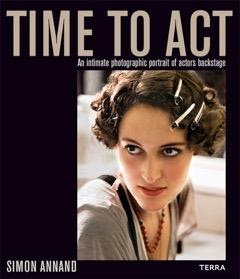
TIME TO ACT a virtual photographic exhibition as actors prepare for curtain up

Time to Act

The thrilling experience of seeing actors live on stage is under threat during the present Covid restrictions. Theatres have been closed and this new book reminds us of what we are missing. Through the eyes of this legendary photographer we observe how the performers get ready to astonish their audience.

To celebrate the publication of Simon Annand’s TIME TO ACT a virtual exhibition will be launched on 5th October (TimeToActPhotos.com) showcasing selected images from the book; some of which will be available for sale. The virtual exhibition will be re-hung on a weekly basis until early November.

The publishers are making a donation from the sale of every book in the UK to The Theatre Artists Fund.

“We are delighted that £1 from every sale of Simon Annand’s new book TIME TO ACT will be donated to The Theatre Artists Fund. We must continue to support the freelance workforce who contribute so much to the theatre industry in this time of crisis” Julian Bird, CEO SOLT

SIMON ANNAND has been shooting photographs backstage at West End theatres in London for 35 years. In these meditative portraits, often shot in the intimate space of the dressing room, he witnesses the focus and tension of world-class actors right before they go on the stage

Simon’s first collection THE HALF was published in 2008 alongside an exhibition at the National Theatre which has subsequently been seen in various other theatres across the UK including Huddersfield’s Lawrence Batley Theatre in 2019.

 “Simon Annand is one of the most amazing photographers I have had the pleasure of working with. He is an individualist with an eye for the unusual.”  Dame Judi Dench

With an introduction by Cate Blanchett, TIME TO ACT continues to explore the moments of vulnerability which every actor experiences before they go onto stage no matter how long they have been working. Amongst the over 230 images are insightful portraits of Gillian Anderson, Cate Blanchett, Orlando Bloom, Phoebe Waller-Bridge, Sharon D Clark, Paapa Essiedu, Jake Gyllenhaal, Lenny Henry, Anthony Hopkins, Andrew Scott, Josette Simon and  Judi Dench.

“It is as difficult to capture actors and creative teams in unselfconscious action as it is to arrest birds in flight [but] there lies Simon’s skill.”  Cate Blanchett

, , , ,

Bristol Old Vic’s Tom Morris: “We have to seize whatever freedom we can find amid all of this confusion and terror.”

Tom Morris
Tom Morris

Tom Morris

“Sometimes I feel like I am married to this building,” Tom Morris says, laughing.

Behind him in shot is the beautiful, slightly darkened auditorium of the Bristol Old Vic: the oldest continuously working theatre in the English speaking world.

Morris gleams out of my screen over Zoom, bright in all senses. He is determined to ensure that the Bristol theatre, where he has been artistic director for more than a decade, survives these dark times.

“There are all sorts of possibilities. It is my job to do whatever I can to help extraordinary artists share their work with the public. Last week as part of a Bristol Ferment commission in the Courtyard space, we projected Saikat Ahamed’s epic poem onto the theatre wall. It seemed to catch the mood.”

Emma Rice’s musical Romantics Anonymous was originally set for an 11 week US tour, but, because of Covid-19 is being performed in Bristol Old Vic’s empty auditorium and streamed to theatres across the UK and internationally as part of an innovative ‘digital tour’.

It has been six months since any actor trod the boards of the theatre but finally the curtains are ready to go up: A sold out one-off socially distanced performance of Rice’s musical is scheduled for this Sunday.

“This week’s live streaming of Romantics Anonymous is a freestanding, astounding and pioneering event dreamed up by the wild imagations of our associate company Wise Children,” Morris says.

Romantics Anonymous

 “And for us, it’s a brilliant kick start to rebuilding our relationship with our audiences as we prepare an Autumn season which has to play to two audiences at once; some live in the theatre; others live at home, watching on line and getting as much as we can deliver of the thrill of being there.”

The performing arts has been one of the hardest hit sectors during the pandemic, with thousands of jobs already lost and unions warning of a “tsunami” to come. Morris, like many other regional theatre executives is awaiting the outcome of their recent submission to the cultural rescue fund courtesy of the Department for Digital, Culture, Media and Sport (DCMS).

“Theatre buildings are pieces of technology that have evolved to do two very different things simultaneously: on the one hand, a theatre is apiece of kit that holds a sacred relationship which connects with ritual in the way Peter Brook and others have described; on the other, it is a piece of technology which puts walls around a performance space in order to gather box office income.   Theatres have always needed to have a foot in business reality and a heart of wild inspiration both at the same time.”

For most theatres, opening to reduced audiences only brings bigger financial problems. The government has indicated that a decision if or when to allow full audiences will not be taken before November.

Dress Rehearsal for Romantics Anonymous

“It has been such a long time coming through austerity and all provincial theatres have had to operate within the margins of viability for some time now.  But right now, I’m absolutely determined that we can find a way through the business side of things.”

“However hard it is, there is something exciting in working out how we can rebuild our creative economy,” says Morris.

“Part of our plan has been a slow rebuild, and that might be interrupted at any time and we may have to stop. But but as we set off on the journey, I am excited by the current radicalism on display from artists and audiences. The challenge is to rebuild something that maintains the business resilience we have learned through austerity with the vision for a fairer, more inclusive and more representative theatre articulated in the best bits of the Arts Council’s plan Let’s Create.”

I bring up Cameron Mackintosh who claimed that more government support should be made available for the large-scale west end theatres and that this would be more beneficial for the sector’s recovery rather than rescuing organisations that are struggling. Any comment?

“Ha Ha,” he replies, adding Mackintosh, could have submitted an application for a huge loan from the recent £1.5bn culture support package fund. “I really hope he did,” says Morris, smiling

“We all know about the terrible impact of missing the freelance workforce out of the Cultural Recovery Fund.  And I am still hopeful that something can be done to remedy that.  But in other respects, such as the provision of loans for commercial organisations alongside grants for others, structure of the fund is very clever.”

Which brings us to the role of large institutions in a Covid-19 era. What, I ask, would a reimagined funding system that prioritised communities instead of large institutions look like? “I think that the building vs people argument is nonsense – predictable nonsense,” he says.  “It’s absolutely clear that you need both.”

 “There just isn’t enough resource within the sector to create radical change by a redistribution of existing resources,” says Morris.

“David Jubb, former artistic director of Battersea Art Centre touched on this in a series of blogs over lockdown  which are truly inspiring and would create a fantastic template for a regional theatre to try, ideally under Jubb’s leadership.  But  I do not think that they form the basis of a viable national policy which risks dismantling the infrastructure which has worked so hard and offered so much economically as well as socially over the last ten years.

“The best way to achieve some of those aims is to use the infrastructure and resources,” he says. “To learn from communities surrounding buildings, in a meaningful way. Especially if we want a talent pipeline and a sense of any substantial  progressions.”

Any final thoughts? 

He pauses.

 “Look.  As of now, we don’t even know whether we can stay half-open until Christmas” he says.

“Never mind whether we will be here in order to rebuild in the new year.  And the consequences of that uncertainty for our staff, our artists, and our audiences are really severe: just as they are for many many parts of the economy.”

He continues. “But as creative leader, however difficult it is, our job is clear:  We have to seize whatever freedom we can find amid all of this confusion and terror, and use it to imagine a better world.”

Romantics Anonymous runs online from Tues 22 – Sat 26 Sep


,

The Olivier theatre to be transformed for live performances in-the-round for socially distanced audiences from October

National Theatre

The Olivier theatre is to be significantly remodelled in order to stage a season of performances in-the-round, which will achieve an audience capacity of almost 500 while maintaining social distancing for audiences.

The National Theatre will reopen to audiences on the 21 October, for the first time since closing in March, with DEATH OF ENGLAND: DELROY, a new play written by Clint Dyer and Roy Williams, directed by Dyer and performed by Giles Terera. The production is the first in a season of productions to be staged in the transformed Olivier theatre. Tickets will go on sale to the public from 2 October with over 200 tickets available at £20 for every performance.

Death of England: Delroy follows on from Death of England that was performed by Rafe Spall and closed just before lockdown. This new work explores a Black working-class man searching for truth and confronting his relationship with Great Britain. Set and costume designers are Sadeysa Greenaway-Bailey and ULTZ, with lighting design by Jackie Shemesh, sound design by Pete Malkin and Benjamin Grant.

In a season when theatres across the country have been forced to postpone their pantomimes by Coronavirus, for one year only, pantomime is coming to the National Theatre. The second production the NT will stage as part of the Olivier in-the-round season will be DICK WHITTINGTON, originally commissioned by the Lyric Hammersmith Theatre, which will celebrate and honour panto’s place at the heart of British theatre.

Jude Christian and Cariad Lloyd’s hilarious and heartfelt version of the famous story was first staged at Lyric Hammersmith in 2018. Freshly updated for 2020, Ned Bennett directs this exciting new production which promises fun for everyone and will open on the South Bank in December.

This wild and inventive production explores what it is like to come from a small town and arrive in a big city today, exploring the ideas of community and togetherness which feel even more prescient in 2020. Making the most of the newly transformed Olivier theatre with set and costume designs by Georgia Lowe, and lighting designed by Jessica Hung Han Yun. Denzel Westley-Sanderson is Associate Director.

Rufus Norris, Director of the National Theatre said: ‘We’re both delighted and relieved to be reopening the National Theatre with the Olivier in-the-round season, which will allow us to present live work to as many people as possible while social distancing remains in place. It is dynamically appropriate to begin the season with DEATH OF ENGLAND: DELROY, an extraordinarily important and timely piece of work by the hugely talented Clint Dyer and Roy Williams, and we are also proud and privileged to be presenting DICK WHITTINGTON this Christmas, helmed by the inspirational Jude Christian, Cariad Lloyd and Ned Bennett. Pantomime is an essential part of the living fabric of our nation, and it is devastating that so many theatres across the country have had no choice but to postpone their pantos this year because of the unprecedented financial impact of Coronavirus. We’ll do all we can to keep the flame alive: brilliant theatre artists will serve up a slice of joy to families on the South Bank, and we’ll be asking everyone to support their local theatres by booking ahead for their 2021 pantomimes. Of course, we hope that it will be possible for theatres to perform safely to fuller audiences long before then.’

Speaking about Dick Whittington, Jude Christian and Cariad Lloyd said: “In 2018 we set out to celebrate the heart of the Dick Whittington story – that London has always been, and will always be, enriched by the brilliant brains and invigorating spirit of those who come from all over the world and call it home. That’s a story we want to tell now more than ever, and in quintessentially British fashion: with irreverent jokes, talking animals, awesome songs, and wholesale destructive silliness.”

Ned Bennett continued: “We are inordinately excited to be talking about a show, never mind having the privilege of being able to stage one right now. We are facing such challenging times, as artists and as an industry, so we feel so lucky to have the NT able to provide this opportunity. We cannot wait to bring audiences (safely) into the Olivier and allow them to remember the joy of theatre for a night.”

Following UK Government guidelines, social distancing measures have been put in place for those attending performances at the NT. These include staggered arrival times, paperless tickets, pre-ordered drinks, enhanced cleaning, and sanitisation stations throughout the theatre. Tickets are available to be purchased as single tickets, as pairs or in threes or fours for audiences to attend with others from their social bubbles. Face coverings will be required at all times, aside from when audience members are eating or drinking. Full information on the safety measures for audiences can be found here.

Further information, including performance dates for DICK WHITTINGTON will be released at a later date. Tickets will go on sale in October.

Royal Opera House Pocket Photobook – an immersive, compact photo guide

Royal Opera House

The Royal Opera House, Covent Garden, presents some of the most accomplished ballet and opera artists in productions of world-renowned quality and remarkable scale. One of the world’s leading performing arts venues, there is often as much interest in the production of performances as in the performances themselves. This fifth title in the Pocket Photo Books series offers an immersive experience of the Royal Opera House via 120 photographs by Harry Cory Wright that capture the charm and the splendour of this London landmark, and an engaging introduction by Chief Executive, Alex Beard CBE.

Harry Cory Wright’s atmospheric, detailed photographs explore every aspect of the Royal Opera House, from the red-and-gold auditorium designed by Edward Middleton Barry and the rehearsal spaces of The Royal Ballet to the fascinating behind-the-scenes workshops where props, wigs, costumes, sets and even weaponry are created onsite with extraordinary skill.

There have been three theatres on the site. The original theatre opened in December 1732 and served initially as a playhouse. The first ballet was performed there in 1734, and the first opera (by Handel, who wrote many operas and oratorios for Covent Garden) later in the same year. The present building – the third on the Covent Garden site following two disastrous fires – opened in 1858 and has been known as the Royal Opera House since 1892. The Covent Garden complex was extensively transformed in several phases during the late 20th and early 21st centuries.

Harry Cory Wright is a leading landscape photographer whose work is concerned with the fundamental sense of place. He has had many solo exhibitions, and in 2013 his work was included in the major exhibition Landmark: The Fields of Landscape Photography at Somerset House, London. In 2017 he featured in the BBC documentary The Man Who Shot Tutankhamun, about photographer Harry Burton, who recorded the Tutankhamun excavation in 1922.

Alex Beard CBE has been Chief Executive of the Royal Opera House since 2013. He has previously worked for Arts Council England and Tate. At the end of 2012 Alex was appointed a CBE for his services to the arts, and was made a Fellow of King’s College London in 2016.